The 12 Greatest Argentine Football Players of All Time: Legends & Icons
"Argentina is not just a country; it is a factory of legends. From humble dirt pitches to the most high-tech stadiums in the world, Argentine footballers stand out for their 'potrero' spirit, exceptional technique, and unwavering resilience.
In this list, we look back at the 12 icons who defined eras and thrilled the entire planet."
1. Lionel Messi: The King of Consistency
To many, he is the Greatest of All Time (GOAT). Messi transformed modern football with a career spanning over 20 years at the pinnacle of the sport, blending extraordinary natural talent with unwavering resilience in the face of adversity.
The Ultimate Achievement: Leading Argentina to the historic "Triple Crown": the 2021 Copa América, the 2022 Finalissima, and the 2022 FIFA World Cup in Qatar.
The Goal That Saved the World Cup: Following the shock defeat against Saudi Arabia, Argentina faced early elimination against Mexico. In the 64th minute, with an entire nation paralyzed by nerves, Messi received the ball outside the box and unleashed a low, pinpoint left-footed strike into the bottom corner past Guillermo "Memo" Ochoa.
Key Detail: This was the goal that unlocked the path to the final. According to FIFA, that shot traveled at over 120 km/h and was recorded as the moment of "highest emotional tension" throughout the entire tournament.
The Dream Final: In the epic final against France, he scored two crucial goals. The second, during extra time (108th minute), was a roar of relief and pure emotion that seemed to seal Argentina's destiny before the legendary penalty shootout.
Legendary Records:
Most appearances in World Cup history: He holds the record with 26 matches played.
The Golden Ball Master: He is the only player ever to win the FIFA World Cup Golden Ball twice (Brazil 2014 and Qatar 2022).
Argentina’s Top Scorer: He surpassed Gabriel Batistuta to become Argentina's all-time leading goalscorer in World Cups with 13 goals.
For the Non-Fan:
Messi is the ultimate example of the "silent hero." For years, he faced harsh criticism in his own country, yet his response was always to work harder. His journey is a masterclass in resilience, proving that true success often arrives only after enduring numerous failures.
Iconic Quotes:
"¡Ya está, ya está!" ("It’s done, it’s over!"), Messi told his family right after winning the World Cup, closing a long chapter of criticism and suffering (Source: TyC Sports, 2022).
Another phrase for the history books came after the heated quarter-finals: "¿Qué mirás, bobo? Andá pa' allá" ("What are you looking at, fool? Move on"), revealing a rebellious and fierce leadership side that made Argentines fall in love with him all over again (Source: Post-match interview vs. Netherlands, 2022).
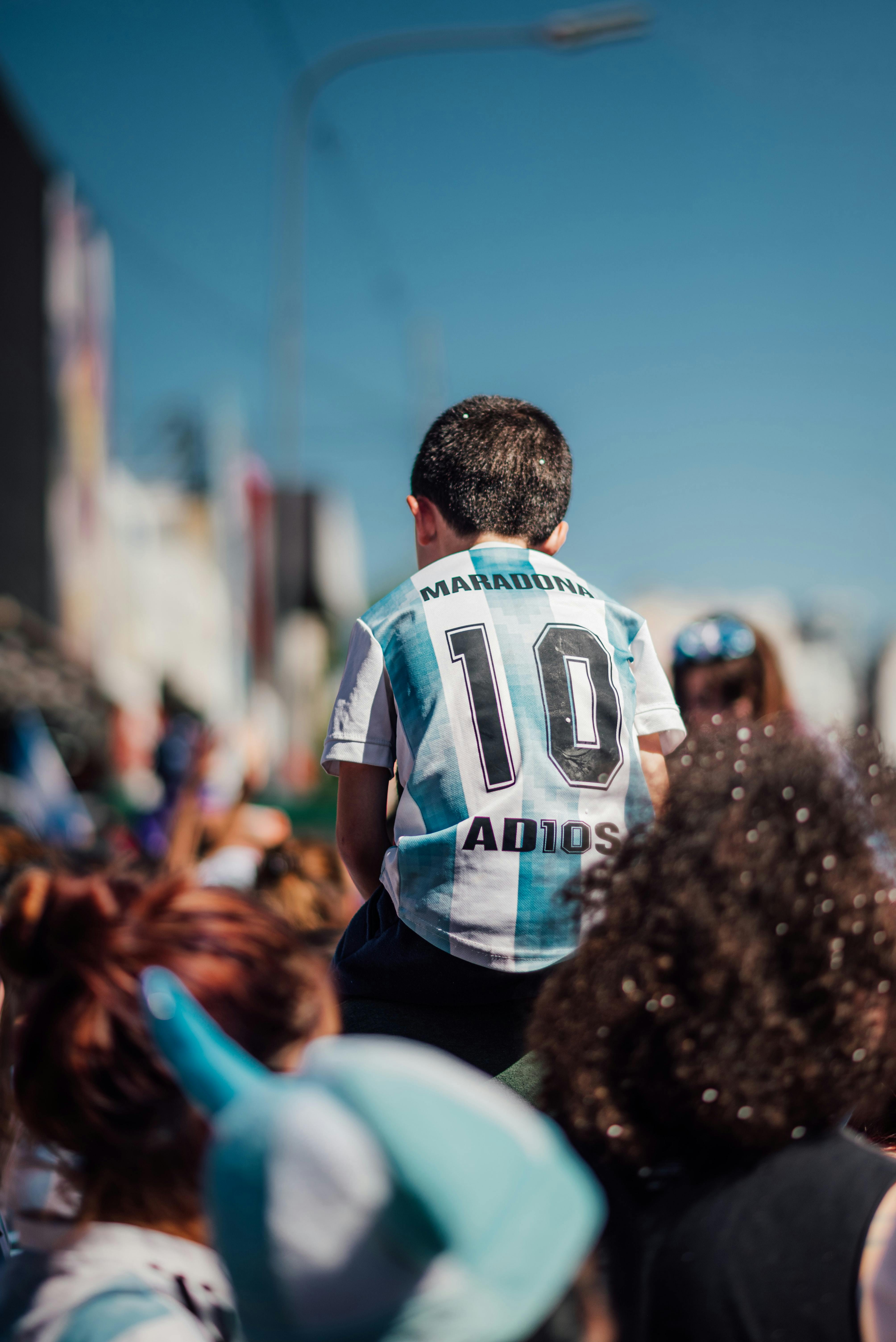
2. Diego Armando Maradona: "D10S"
More than just a player, Diego was a cultural icon. He represented the spirit of rebellion and the raw talent of the Argentine "potrero" (neighborhood sandlots) taken to its ultimate global expression.
The Ultimate Feat (Mexico '86): On June 22, 1986, at the Estadio Azteca, Maradona created football's greatest masterpiece: the "Goal of the Century" against England. In just 10.6 seconds and covering 60 meters, he dribbled past four English defenders and goalkeeper Peter Shilton. This goal carried immense social weight for Argentina, taking place only a few years after the Falklands War (Guerra de Malvinas).
The Commentary That Made Him Eternal: The play was immortalized by the voice of Víctor Hugo Morales, who famously dubbed him the "Cosmic Kite" (Barrilete Cósmico).
The Quote: "Cosmic kite! What planet did you come from, to leave so many Englishmen behind, so that the country could become a clenched fist crying for Argentina?" (Source: Radio Continental, 1986).
For the Non-Fan: Maradona didn’t just win trophies; he transformed realities. He famously led a humble Napoli side to win two Scudettos (1987 and 1990), challenging the economic dominance of Northern Italy. To this day, he remains a secular saint and a religious-like idol in the city of Naples.
Key Detail: In that same match against England, just minutes before his masterpiece, he scored the infamous “Hand of God”. This match perfectly showcased the two sides of his genius: cunning mischief and technical perfection.
Iconic Quote: "I made mistakes and I paid for them, but the ball is never stained" (Source: Farewell speech at La Bombonera, 2001).
3. Alfredo Di Stéfano: The "Saeta rubia"
Before the world debated between Messi and Maradona, there was only one answer: Di Stéfano. He was the architect of the most dominant Real Madrid in history, winning 5 consecutive European Cups.
"A scorer with staggering figures, a winner in Argentina, Colombia, and Spain, and recognized worldwide. Alfredo Di Stéfano was the 'Blond Arrow' of football due to his incredible speed and the color of his hair." (SOURCE: Cadena3 – Article by Jorge Parodi)
Club Career (The Global Phenomenon):
- River Plate (Argentina): He was part of the legendary forward line known as "La Máquina" (The Machine). He was the top scorer of the Argentine league in 1947, where his nickname was born from his electric speed.
- Millonarios (Colombia): He led the famous "Ballet Azul" (Blue Ballet). This team marveled the world and defeated Real Madrid in their own stadium, prompting the Spanish club to do the impossible to sign him.
- Real Madrid (Spain): The place where he changed the history of European football, scoring 308 goals in 396 official matches.
Unique Feat: The Super Ballon d'Or
In 1989, France Football magazine decided to award a unique prize to commemorate its 30th anniversary. Di Stéfano beat Johan Cruyff and Michel Platini in the voting, becoming the only footballer on the planet to possess a Super Ballon d'Or.
SEO Insight: This is a "niche" fact that attracts high search volume from collectors and football historians.
The Unbeatable Record: He is the only player to have scored in five consecutive European Cup finals (now the Champions League), winning all of them between 1956 and 1960.
Legacy and Recognition:
Pelé: The Brazilian legend stated on several occasions: "People debate Pelé or Maradona. For me, the best was Di Stéfano."
Eusébio: The Portuguese legend considered him his master: "Di Stéfano was the most complete footballer I have ever seen."
Real Madrid: The stadium where the first team trains and Real Madrid Castilla plays carries his name, honoring the man who transformed the club into the greatest of the 20th century.
For the Non-Fan: Di Stéfano did not have a fixed position. He could defend in his own box, organize the game in the midfield, and finish the play as a striker. He was the precursor to what we know today as "Total Football."
Iconic Quotes:
"No player is as good as all of them together."
"A football match without goals is like a Sunday without sun."
(Source: "Alfredo Di Stéfano's Best Quotes," ABC.ES).
4. Mario Alberto Kempes: The Matador
The hero of Argentina's first World Cup star in 1978, breaking a historical drought and leading the Albiceleste to the top of the world for the first time.
Club Career (An Icon Across Two Continents):
Rosario Central (Argentina): Where he exploded as an implacable goalscorer, becoming the club's all-time leading scorer in the professional era.
Valencia CF (Spain): His home away from home. He won two consecutive "Pichichi" trophies (La Liga's top scorer) and led the club to win the Copa del Rey, the UEFA Cup Winners' Cup, and the UEFA Super Cup. For many, he is the greatest idol in Valencia's history.
River Plate (Argentina): He returned to his country to become a champion in 1981, forming a stellar team alongside a young Diego Maradona.
World Cup Feat: The 1978 Triple Crown
Kempes achieved something very few have done in World Cup history: in the same tournament, he was World Champion, Top Scorer (Golden Boot with 6 goals), and Best Player (Golden Ball).
Historical Anecdote: Curiously, he did not score any goals in the first round of the tournament. César Luis Menotti, the coach, suggested he shave his moustache to "change his luck." It worked: from the second round onwards, he couldn't stop scoring.
The Goal that Stopped Time: His two goals in the final against the Netherlands at a Monumental Stadium covered in papelitos (confetti) are images etched into the DNA of Argentine sports. His power to carry the ball through the Dutch defenders defined the style of the Argentine striker: brave, powerful, and technical.
How He Is Remembered:
Diego Maradona: He always acknowledged that Kempes was his inspiration. "Kempes put Argentine football on the world map," Maradona stated in his biography Yo soy el Diego (Source: Editorial Planeta).
Córdoba City: The main stadium in his home province, one of the most modern in Argentina, is named after him: Estadio Mario Alberto Kempes.
Valencia Fans: To this day, the chant is still heard at Mestalla: "Don't say Kempes, say Goal!"
For the Non-Fan: Kempes represented hope during a very dark political and social time in Argentina. His football was a balm, and his post-championship humility (he didn't stay for official celebrations, preferring to go home to his family) made him an example of a low-profile hero.
"I remember that World Cup as something very beautiful. I will never forget it... We knew we had 25 million Argentines waiting for us to score a goal to enjoy. But that wasn't pressure. On the contrary: it was a satisfaction to wear the shirt and feel supported by those people." (Source: Interview in El Cronista).
The Goal That Stopped Time: His two goals in the final against the Netherlands at a Monumental Stadium covered in white confetti (papelitos) are images etched into the DNA of Argentine sports. His raw power to drive the ball through the "Orange" defenders defined the quintessential Argentine striker: gritty, powerful, and technical.
Who Remembers Him Best? (Mario Kempes)
- Diego Maradona: He always acknowledged that Kempes was his primary inspiration. "Kempes put Argentine football on the world map," Maradona stated in his biography Yo soy el Diego (Source: Editorial Planeta).
- The City of Córdoba: The main stadium in his home province—one of the most modern in Argentina—is named after him: Estadio Mario Alberto Kempes.
- Valencia Fans: To this day, the following chant can still be heard at the Mestalla stadium: "¡No digan Kempes, digan gol!" (Don't say Kempes, say goal!).
For the Non-Fan:
Kempes represented hope during a very dark political and social period in Argentina. His football acted as a balm for the nation, and his post-championship humility (he skipped the official celebrations to go home and spend time with his family) made him the ultimate example of a "low-profile" hero.
"I remember that World Cup as something beautiful. I will never forget it. It took us a tremendous effort to calm down. We knew we had 25 million Argentines waiting for us to score a goal to enjoy. But that wasn't pressure; on the contrary, it was a profound satisfaction to wear the shirt and feel supported by these people." (Source: Interview with El Cronista).
5. Ángel Di María: The Man for Finals
Known as "El Fideo" (The Noodle), Di María’s journey is one of redemption. He went from being heavily scrutinized by the press and fans to becoming the author of the most important goals in Argentina’s modern history.
Key Goals: He is a "clutch player" who scored in the 2008 Olympic Final, the 2021 Copa América Final, the 2022 Finalissima, and the 2022 World Cup Final.
Messi’s Greatest Ally: He is widely considered the best on-field partner Lionel Messi has ever had in the national team.
The Goal That Broke the Curse:
Di María’s goal against Brazil in the 2021 Copa América Final ended a 28-year trophy drought for Argentina. He was the man responsible for "silencing" the Maracaná Stadium in that legendary match.
The Masterclass Play:
In the 22nd minute of the first half, Rodrigo De Paul launched a pinpoint long pass that soared over the Brazilian defense. Di María, with his characteristic elegance, controlled the ball perfectly and, as goalkeeper Ederson rushed out, finished with a subtle "vaselina" (chip shot) that drifted into the back of the net.
Historical Relevance:
That goal was more than just the 1-0 winner against Brazil; it acted as the catalyst that relieved the immense pressure on Lionel Messi and the entire squad. It was the spark that ignited the golden era of the “Scaloneta.”
ETERNAL DI MARIA: THE 11 ICONIC MOMENTS WITH THE NATIONAL TEAM:
6. Daniel Passarella: "The Great Captain"
If Argentine football had a face for authority, it would be Passarella’s. He was the undisputed leader who hoisted the first World Cup in 1978 and the defensive benchmark who defined an era at River Plate and in the Italian Calcio.
A Unique Feat: The Only Double World Champion
Daniel Passarella holds a record that neither Messi nor Maradona can claim: he is the only Argentine player to be part of two World Cup-winning squads (Argentina 1978 and Mexico 1986).
Historical Detail: In '78, he was the captain and the soul of the team. In '86, although he was on the roster, he couldn't play due to a severe intestinal infection and injury. However, FIFA officially recognizes him as a two-time champion (Source: TyC Sports - The Cursed Mexico '86 of Passarella).
A Defender with a Striker’s Instinct (IFFHS Statistics)
For decades, he was the highest-scoring defender in the history of world football, a record only later surpassed by Ronald Koeman.
The Numbers: He scored 175 goals in 551 official matches. This statistic places him as the defender with the best goal-scoring average in the history of both the Argentine National Team and River Plate (Source: IFFHS - International Federation of Football History and Statistics).
The "Magnet" of the Box: A Jump That Defied Physics
Despite being only 1.73 meters tall (5'8")—relatively short for a center-back—Passarella possessed an extraordinary vertical leap that allowed him to out-jump much taller strikers.
Curiosity: It was often said he had a "magnet" in his head. His heading technique, both for clearing and attacking, is still studied in football academies today. El Gráfico magazine described him as: "A center-back who played in the air as if he had invisible stairs" (Source: Historical Archive, El Gráfico Magazine).
Club Career:
- River Plate: He is the club's ultimate defensive idol, winning 7 titles as a player.
- Fiorentina & Inter Milan: In Italy, he is remembered as one of the greatest foreign defenders in Serie A history, during an era when the Calcio was the most difficult league in the world.
Passarella was nicknamed "The Kaiser" in reference to the legendary Franz Beckenbauer. His leadership was so commanding that it was said even referees respected him. He was an "iron-fist" leader, famous for his discipline and for never negotiating effort on the pitch.
7. Gabriel Batistuta: "El Batigol"
For years, he was Argentina’s all-time leading scorer before Lionel Messi arrived to break every record. He was a striker who didn't just shoot at the goal; he seemed to want to blast through goalkeepers with strikes that defied the laws of physics.
A Unique World Cup Record:
Batistuta holds a record that neither Messi, Maradona, nor even Cristiano Ronaldo has achieved: he is the only player in history to score a hat-trick in two different World Cups (against Greece in USA 1994 and against Jamaica in France 1998).
A 20-Year Legacy:
For two decades, he was Argentina’s top scorer in World Cup history with 10 goals, a title he held until he was finally surpassed by Messi during Qatar 2022 (Source: TyC Sports).
The Torch Passing:
Upon losing his record, Batistuta sent a heartfelt message to the current captain: “Dear Leo, congratulations! I held the record for 20 years and I enjoyed it. Now it is a great honor and pleasure to share it with you, hoping with all my heart that you can surpass it in the next match!”
The Lion King of Florence (An Icon in Italy)
His time at Fiorentina is the stuff of legend. During an era when the Italian Serie A was the undisputed "league of stars," Batistuta scored 207 goals in 332 matches.
The Ultimate Loyalty: His commitment to the club was so deep that he stayed with the team even after they were relegated to Serie B, eventually leading them back to the top flight. In 2014, he was inducted into the Fiorentina Hall of Fame; years earlier, the fans had already erected a life-size statue in his honor at the stadium (Source: ACF Fiorentina Official Website).
The Dream Title: He finally reached the pinnacle of Italian football by winning the Scudetto with AS Roma in 2001, forming an unforgettable attacking trident alongside Francesco Totti and Vincenzo Montella.
The Human Sacrifice: "I asked the doctor to amputate my legs"
For the non-fan, Batistuta’s story is a harrowing tale of resilience and physical toll. His devotion to the game was so extreme that he played through years of chronic ankle pain, relying on constant painkilling injections just to step onto the pitch.
The Chronicle of Pain: Years after his retirement, he confessed in a gut-wrenching interview that the agony had become so unbearable he begged his doctor to amputate his legs.
"I would wet the bed because I simply couldn't get up; the pain in my ankles was too much to bear," he recounted (Source: TyC Sports Interview / 'El Número Nueve' Documentary).
"I went to see Dr. Avanzi and told him to cut off my legs. He looked at me and said I was crazy. I insisted; I couldn't take it anymore... I can't describe the pain; it’s impossible to convey it to people" (Source: CONMEBOL.COM). Fortunately, a successful prosthetic surgery in 2019 finally restored his mobility.
For the Non-Fan:
Batistuta was more than a goalscorer; he was a gentleman of the sport. Despite his worldwide fame, he maintained a low profile and an impeccable work ethic. He remains the ultimate symbol of sacrifice: giving everything—including his long-term health—for the glory of his country.
Lionel Messi on Batistuta: "Batistuta was a role model for all of us. Breaking his record was an honor because we know what he means to our national team." (Source: Post-match statements, Copa América Centenario 2016).
8. Emiliano "Dibu" Martínez: The Guardian of the Goal
Although his consolidation in the Argentine National Team came late—making his debut at age 28—the impact of "Dibu" has been unprecedented. In less than three years, he transformed from a perennial substitute in England into the undisputed owner of the Argentine goal and a global cultural icon.
The Sacrifice of a 12-Year-Old Boy:
Born in Mar del Plata, Emiliano left his family as a mere child to move into the boarding house of Independiente in Avellaneda. The engine behind his effort was the reality of his home: seeing his father (a port worker) and his mother (a house cleaner) struggle to make ends meet. "I saw my dad cry because he couldn’t pay the bills," he has recalled on several occasions, marking that moment as the birth of his hunger for glory.
The Premature Exile and the "Solitude" of London:
At 17, without having even debuted in Argentina’s first division, Arsenal FC bought his contract. Martínez accepted the offer not for fame, but out of necessity. He spent a decade being loaned from club to club in the lower tiers of English football (Oxford, Sheffield Wednesday, Rotherham, Reading), living through years of anonymity and frustration while waiting for an opportunity that seemed destined never to arrive.
His big break finally came in 2020 following an injury to his teammate at Arsenal. Since then, his rise has been unstoppable. His "unknown" history explains why, in that 123rd minute against Kolo Muani, his legs didn't tremble: it was the result of 10 years of fighting against oblivion in England.
The Back-to-Back Yashin Trophy Winner:
Martínez made history at the Ballon d'Or galas by becoming the first goalkeeper in history to win the Yashin Trophy twice consecutively (2023 and 2024), the award given by France Football to the best goalkeeper on the planet.
The Save of All Time (122:43):
In the final seconds of the Qatar 2022 Final, Martínez starred in what FIFA and various analysts call "the most decisive save in history." At the 123rd minute, he used his left leg to block a point-blank shot from Randal Kolo Muani that would have secured the title for France.
The "Anti-Dibu" Law (Changes to the Rules of Football):
The "trash talk" and psychological methods employed by Emiliano Martínez—both against the Netherlands in the quarter-finals and against France in the final (and previously in the Copa América)—did not go unnoticed by the authorities. As a result, a new regulation was launched, quickly dubbed by global media as the "Anti-Dibu Law," which changes how goalkeepers can behave during penalty shootouts.
The new Rule 14 establishes that goalkeepers can no longer touch the posts or nets, nor distract the kicker in an "irrespectful" manner. This modification is now a permanent part of football's disciplinary history.
"Mirá que te como, hermano" ("Watch out, I'm gonna eat you up, brother"), the phrase he immortalized during the penalty shootout against Colombia, has become a trademark of his competitive style.
9. Omar Sívori: "El Cabezón"
A superstar of the 1950s and 60s, Sívori was a wizard who dazzled at both River Plate and Juventus. He was the bridge between the classic era and the modern game, bringing the rebel spirit of the Argentine streets to the elite stages of Europe.
The "Transfer of the Century" That Built a Stadium:
Sívori didn’t just bring glory to River Plate on the pitch; he literally helped finish their home. In 1957, he was sold to Juventus for a then-record fee of 10 million pesos.
Historical Impact: River used that staggering sum to complete the construction of the north stand at the Estadio Monumental. In an act of poetic justice, that stand now bears his name: the Omar Sívori Stand (Source: TyC Sports).
1961 Ballon d’Or (A National Pride):
Sívori was the second Argentine-born player to win the Ballon d’Or (after Di Stéfano). He achieved this as an "oriundo" (an Argentine with Italian citizenship), but he always remained true to his Rioplatense street-football style. At Juventus, he formed the legendary "Holy Trident" alongside John Charles and Giampiero Boniperti, scoring 167 goals and winning three Scudettos.
The "Angels with Dirty Faces":
He was the centerpiece of one of the greatest forward lines in the history of the Argentine National Team: the "Angels with Dirty Faces" (Los Ángeles de Cara Sucia) who won the 1957 South American Championship in Lima. They earned the name because they played like children in the mud—full of mischief, flair, and zero fear of the continent's defensive giants.
The Sívori Style: Defying the Defenders
His trademark was playing with his socks rolled down and no shinpads. It was a direct challenge to defenders; he was essentially saying, "Here are my legs, try and hit me." He lived for the "nutmeg" (túnel), using it not just to advance the play, but to playfully humiliate his opponents.
For the Non-Fan:
Sívori represents the transition of football from a mere sport to a global spectacle. He was one of football’s first true "celebrities" in Italy, known for his glamorous lifestyle and an explosive temper that often led to heated clashes with referees and managers alike.
10. Javier Zanetti: "El Pupi"
The ultimate example of professionalism and longevity. Javier Zanetti is not just an Argentine legend; he is a cornerstone of Italian football heritage. Known as "Il Capitano" and "The Tractor," his tireless work rate and physical fitness became the stuff of legend across the globe.
Historic Feat: The Treble Captain (2010)
Zanetti led Inter Milan to achieve the historic "Treble" (winning the Serie A, Coppa Italia, and the UEFA Champions League) in 2010. He was the first captain of an Italian club to ever reach this monumental achievement.
Appearance Record: The Inter Icon
He holds the record for the most matches played in Inter Milan’s history, with a staggering total of 858 official appearances. His loyalty to the Nerazzurri made him one of the most respected figures in the sport.
National Team Statistics:
For many years, he was the most capped player in the history of the Albiceleste (with 143 or 145 appearances depending on the source), a record that was only later surpassed by Javier Mascherano and Lionel Messi.
The Science of Longevity:
Zanetti retired in 2014 at the age of 40, after 19 uninterrupted seasons at the highest level in Europe.
For the Non-Fan:
Zanetti’s fitness was so legendary that it was often joked he was "ageless." He famously trained on his wedding day and during his holidays. Even at 40, Inter’s medical staff reported that his strength and endurance tests were identical to those of a 20-year-old athlete. Off the pitch, he is a tireless humanitarian through his PUPI Foundation, which supports vulnerable children in Argentina.
Current Role: He currently serves as the Vice-President of Inter Milan and is a member of FIFA’s Social Responsibility Committee.
Point of Interest:
Legend has it that Zanetti never skipped a training session, not even on his wedding day or during family holidays. Inter Milan’s medical staff confirmed that even at the age of 40, his strength and endurance tests were identical to those of a 20-year-old elite athlete, a testament to his legendary work ethic and physical discipline.
For the Non-Fan:
Beyond the pitch, Javier is widely respected for his humanitarian work through the PUPI Foundation, which supports vulnerable children in Argentina. His career is also a beacon of Fair Play: in nearly 1,000 professional matches, he was sent off only twice, maintaining an impeccable reputation for sportsmanship throughout two decades at the highest level.
CURRENT ROLE: Vice President of Inter Milan and member of the FIFA Social Responsibility Commission.
“The commitment to using the power of football to generate positive changes in society guides all of FIFA's activities. The organization works tirelessly [...] to ensure that football is accessible to all and that respect and safety in football environments are not a privilege, but a fundamental right.” (Source: FIFA.com)
11. Ubaldo Fillol: "El Pato," Master of the Goal
To the majority of football historians, Fillol is the greatest goalkeeper Argentina has ever produced. His style was not merely defined by his cat-like reflexes, but by a supernatural intuition that seemed to allow him to predict exactly where a ball was headed before the striker even made contact.
World Cup Hero: The Architect of the First Star (1978)
Fillol was the backbone of Argentina's first-ever World Cup victory in 1978. His legendary performance in the final against the Netherlands—specifically his miraculous save against Johnny Rep—and his crucial penalty save against Kazimierz Deyna (Poland) remain peak moments in the history of the Albiceleste.
The Best in the World:
He was officially named the Best Goalkeeper of the 1978 World Cup and was included in the tournament's All-Star Team (Source: FIFA Museum / AFA Archive).
The All-Time Penalty Record:
Fillol holds a staggering record in Argentine football history: he is the goalkeeper with the most penalty saves in the history of the local league, with a total of 45 saves (Source: "Guardians of the Box: The Argentine Goalkeepers with the most penalty saves," El Gráfico Magazine).

A Legendary Career
Fillol shone at River Plate, where he secured 7 titles, but his influence extended far beyond Argentina. He left an indelible mark in Brazil with Flamengo and in Spain with Atlético de Madrid. Demonstrating incredible longevity, he retired at the age of 40 while playing for Vélez Sarsfield, famously saving a penalty in his very last official match—a poetic end to a storied career.
For the Casual Observer:
His nickname "Pato" (Duck) originated from his unique gait and his exceptionally elastic, almost supernatural movements between the posts. Fillol is also the central figure in the world-renowned "Abrazo del Alma" (The Soul's Embrace) photograph. Taken moments after the 1978 World Cup victory, it remains one of the most poignant images in Argentine culture: it captures a fan without arms rushing onto the pitch to embrace Fillol and teammate Alberto Tarantini in a display of pure, unfiltered emotion.

"I touched the sky, my friend. I can assure you that thanks to football, I touched the sky with my own hands..." (SOURCE: Infobae)
"When I arrived here back in 1973, I said that River's goal is the biggest in the world. That phrase went down in history. Now, as I approach 70, I’m going to change it. It’s the same frame as any other, but it is the goal with the most history in the world. And that makes it immense and difficult." (Source: cariverplate.com.ar – Rubén Sagarzazu)
12. Juan Román Riquelme: The Last “10”
Riquelme didn’t just play football; he dictated the rhythm of the entire match. He is the standard-bearer of an endangered species: the traditional "enganche" (playmaker) who used his mind before his feet.
Feat: Won 3 Copa Libertadores titles with Boca Juniors and delivered a world-class performance against Real Madrid in the 2000 Intercontinental Cup.
The Philosophy: "Football has given me everything; I’m going to kiss the ball until the last day I play."
Club Career:
- Boca Juniors: Where he became an immortal idol (across 3 separate stints).
Fan Experience Tip: Visiting Riquelme's "backyard"—the legendary La Bombonera—is a dream for any true football enthusiast. For those looking to secure a museum visit and explore the mythic stadium safely with an expert guide, platforms like Daytours4u or Tangol offer tailored packages, allowing travelers to focus solely on soaking in the atmosphere.
- FC Barcelona: His stint in Europe where, despite his immense talent, he clashed with the rigid tactical systems of manager Louis van Gaal.
- Villarreal CF: He led a modest Spanish side to the semi-finals of the UEFA Champions League, transforming the club's history forever.
- Argentinos Juniors: His boyhood club, where he returned to secure their promotion to the first division and retire as a true gentleman of the game.
A Historical Landmark: The Night He Humiliated the "Galácticos" (2000)
In the 2000 Intercontinental Cup Final, Riquelme put on a footballing clinic against a Real Madrid side featuring icons like Luís Figo and Roberto Carlos. For 90 minutes, he shielded and moved the ball with such mastery that even defensive specialists like Claude Makélélé were unable to dispossess him.
Copa Libertadores Records:
He is the player with the most matches played at La Bombonera in the history of the Copa Libertadores.
A 3-time Copa Libertadores Champion (2000, 2001, 2007). His 2007 campaign is widely considered by the specialized press as the greatest individual performance in the tournament's history, scoring 8 goals, including two in the final against Grêmio.
The Icons Who Admire Him:
Zinedine Zidane: The French legend asked to swap his final professional jersey with Román, stating: "If I were a manager, Riquelme would always be in my starting eleven."
Andrés Iniesta: He has stated on multiple occasions that learning from Román during their time at Barcelona was fundamental to his development.
Villarreal CF: The Spanish club inducted him into their "Hall of Fame" for elevating them to the European elite.
The "Topo Gigio":
The true story behind his famous celebration (cupping his hands behind his ears) was not just a gesture; it was an act of rebellion against the club’s directors, defending his rights and those of his teammates. It remains a symbol of intelligence, defiance, and pride (Source: TyC Sports).
"The ball gave me everything. It is the most beautiful toy in existence." (Source: Interview with Horacio Pagani, TyC Sports).
The passion described in these 12 Greatest Players list remains alive in every stadium across Buenos Aires today. If you are looking to witness the next historic feat from the stands, we highly recommend exploring the experiences offered by Futboltour, Tangol, and Daytours4u. These expert agencies specialize in connecting international travelers with the vibrant and electrifying atmosphere of Argentine football.